Cut toFrame 0304
Home
CASE 02 — Healthcare · AI co-pilot
Choosing a Medicare plan at 65
Case sheetCase No. 02
- Project
- Choosing a Medicare plan at 65
- Client
- US health insurer
- Category
- Healthcare · AI co-pilot
- Year
- 2022–23
- Role
- UX lead, pitch track
- Team
- India + Boston CX team
LeadAmit Chotia2022–23
 Healthcare · AI co-pilot
The short version
Meet Mona: 65, retiring this fall, facing a complexity of choices — and the one agent she trusts is on holiday. From transactional to intelligent.
Outcome
Prototype credited in winning the engagement
The brief
Mona is 65, retiring this fall, and needs a Medicare Advantage plan within the enrolment window. The choices are complex, and the one agent she trusts with her health records is on holiday.
The brief: an end-to-end enrolment experience for a US health insurer — from transactional to intelligent. Before any design work, a sentiment analysis of the research brief and the market told us that around two-thirds of what customers felt was negative.
Start with Mona, not the plan
We opened the pitch with a person rather than a product. Mona is 65, a retired accountant, retiring this fall and moving into a new setup of life. She needs a Medicare Advantage plan inside the enrolment window — and the one agent she trusts with her health records is on holiday.
Every decision after this had to answer one question: does this help Mona decide, on her own, without feeling she chose wrong?

Two-thirds of what people felt was negative
Before any screen, we ran a sentiment analysis across the research brief and the market. Around 66% of the sentiment was negative and about 30% neutral and adaptable. The themes were familiar but sharp: overwhelming information, cost-consciousness, health concerns, data privacy, a complex and lengthy process, and plans that went quiet after activation.
That number set the brief. We weren't designing a better catalogue of plans — we were designing confidence.

Four moments that decide trust
We shaped the enrolment around four moments: onboarding that asks about Mona before it shows plans; prescription savings that switch her to a generic or mail-order when it's cheaper; cost-saving options that put a real number on the screen (save up to $260 on a co-pay); and post-enrolment, where an onboarding checklist keeps going after the purchase.
The last one mattered most. The fear of having chosen wrong doesn't end at checkout — so neither should the journey.

Mona at 68, relocating mid-year
For the second pitch we moved the story forward. Mona is now 68, a loyal member, relocating to another state mid-year — and again in an immediate need for a new plan. This time she stumbles on a Customer Co-Pilot, an AI assistant that stays with her across the shopping journey.
We designed it across three interaction models, so we could show the client where AI helps and where a human should take over.

What we know, what we can know, what we should know
We framed the Co-Pilot in three layers. What we know (being reactive): her history, her doctors, her claims. What we can know (being proactive): offering contextually relevant information she might overlook. What we should know (being predictive): building personalised health scenarios that help her choose.
Adaptive AI learning let it notice the moments that needed a person, and hand over smoothly to chat or tele-sales — instead of pretending to be one.


Text and speech, one conversation
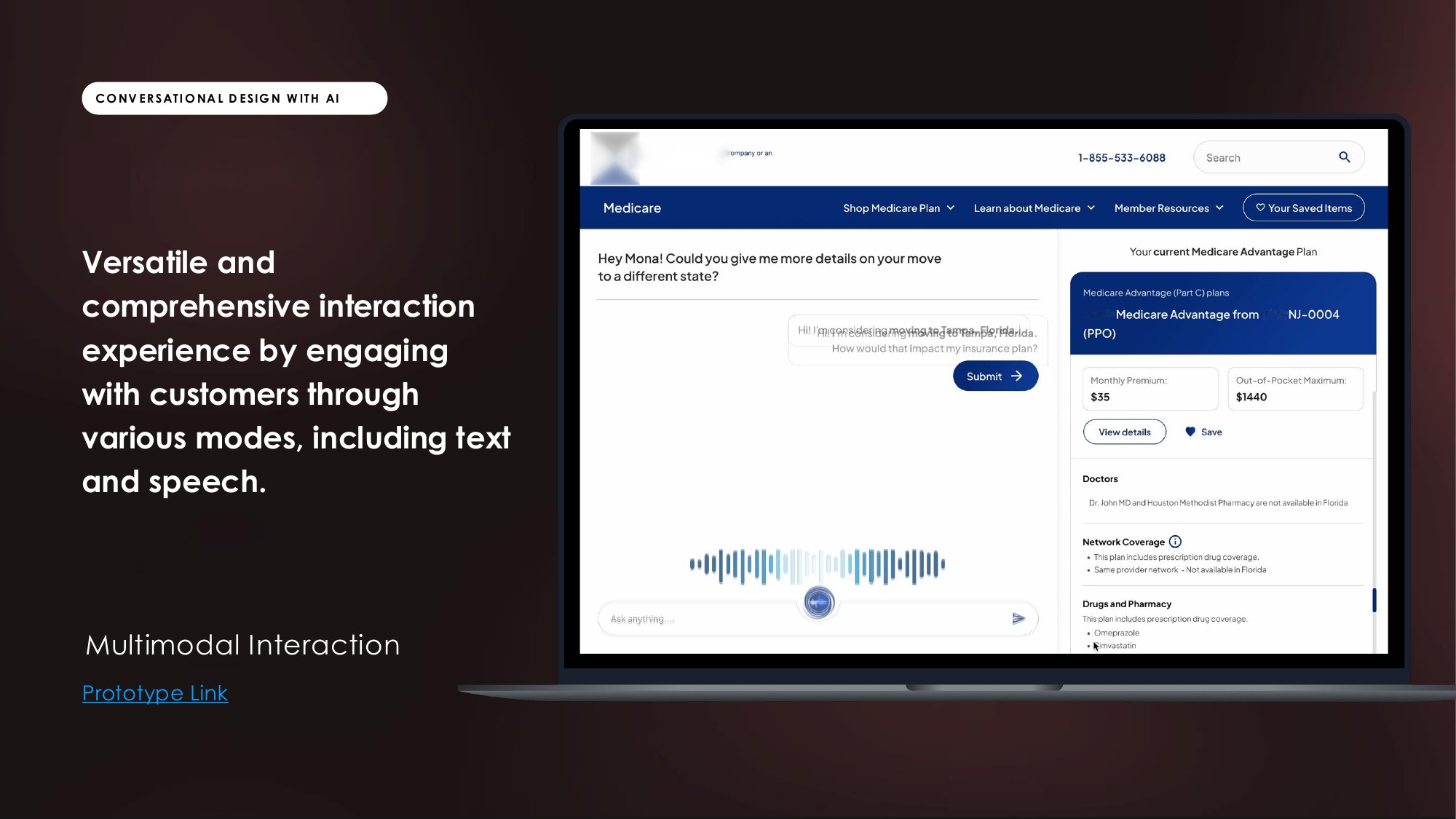
The final prototype let Mona ask the way she'd ask an agent — by typing or by speaking — and see her current plan, doctors, network coverage and drug costs update alongside the conversation.
The pitch team took the click-through prototype to the client. It was credited as a significant part of winning the engagement.
The result
A click-through prototype across text and speech that the pitch team took to the client — credited as a significant part of winning the engagement.
- Take 1
- ~66%
- Negative sentiment, before design
- Take 2
- 4
- Journey stages redesigned
- Take 3
- 3
- AI interaction models
 1Next · 03Open case
Next case · 03 / 12
Rewards for people who live on the road
US travel-centre network · Loyalty · Mobile · Voice · Sales POC
An unbiased, unconventional review of a truck-stop rewards app for 1M+ guests — starting with the trucker, not the points.
CASE 02 — Healthcare · AI co-pilot
Choosing a Medicare plan at 65
Case sheetCase No. 02
- Project
- Choosing a Medicare plan at 65
- Client
- US health insurer
- Category
- Healthcare · AI co-pilot
- Year
- 2022–23
- Role
- UX lead, pitch track
- Team
- India + Boston CX team
LeadAmit Chotia2022–23
Healthcare · AI co-pilotThe short version
Meet Mona: 65, retiring this fall, facing a complexity of choices — and the one agent she trusts is on holiday. From transactional to intelligent.
Outcome
Prototype credited in winning the engagement
The brief
Mona is 65, retiring this fall, and needs a Medicare Advantage plan within the enrolment window. The choices are complex, and the one agent she trusts with her health records is on holiday.
The brief: an end-to-end enrolment experience for a US health insurer — from transactional to intelligent. Before any design work, a sentiment analysis of the research brief and the market told us that around two-thirds of what customers felt was negative.
Start with Mona, not the plan
We opened the pitch with a person rather than a product. Mona is 65, a retired accountant, retiring this fall and moving into a new setup of life. She needs a Medicare Advantage plan inside the enrolment window — and the one agent she trusts with her health records is on holiday.
Every decision after this had to answer one question: does this help Mona decide, on her own, without feeling she chose wrong?
Two-thirds of what people felt was negative
Before any screen, we ran a sentiment analysis across the research brief and the market. Around 66% of the sentiment was negative and about 30% neutral and adaptable. The themes were familiar but sharp: overwhelming information, cost-consciousness, health concerns, data privacy, a complex and lengthy process, and plans that went quiet after activation.
That number set the brief. We weren't designing a better catalogue of plans — we were designing confidence.
Four moments that decide trust
We shaped the enrolment around four moments: onboarding that asks about Mona before it shows plans; prescription savings that switch her to a generic or mail-order when it's cheaper; cost-saving options that put a real number on the screen (save up to $260 on a co-pay); and post-enrolment, where an onboarding checklist keeps going after the purchase.
The last one mattered most. The fear of having chosen wrong doesn't end at checkout — so neither should the journey.
Mona at 68, relocating mid-year
For the second pitch we moved the story forward. Mona is now 68, a loyal member, relocating to another state mid-year — and again in an immediate need for a new plan. This time she stumbles on a Customer Co-Pilot, an AI assistant that stays with her across the shopping journey.
We designed it across three interaction models, so we could show the client where AI helps and where a human should take over.
What we know, what we can know, what we should know
We framed the Co-Pilot in three layers. What we know (being reactive): her history, her doctors, her claims. What we can know (being proactive): offering contextually relevant information she might overlook. What we should know (being predictive): building personalised health scenarios that help her choose.
Adaptive AI learning let it notice the moments that needed a person, and hand over smoothly to chat or tele-sales — instead of pretending to be one.
Text and speech, one conversation
The final prototype let Mona ask the way she'd ask an agent — by typing or by speaking — and see her current plan, doctors, network coverage and drug costs update alongside the conversation.
The pitch team took the click-through prototype to the client. It was credited as a significant part of winning the engagement.
The result
A click-through prototype across text and speech that the pitch team took to the client — credited as a significant part of winning the engagement.
- Take 1
- ~66%
- Negative sentiment, before design
- Take 2
- 4
- Journey stages redesigned
- Take 3
- 3
- AI interaction models
1Next · 03Open caseNext case · 03 / 12
Rewards for people who live on the road
US travel-centre network · Loyalty · Mobile · Voice · Sales POC
An unbiased, unconventional review of a truck-stop rewards app for 1M+ guests — starting with the trucker, not the points.
CASE 02 — Healthcare · AI co-pilot
Choosing a Medicare plan at 65
Case sheetCase No. 02
- Project
- Choosing a Medicare plan at 65
- Client
- US health insurer
- Category
- Healthcare · AI co-pilot
- Year
- 2022–23
- Role
- UX lead, pitch track
- Team
- India + Boston CX team
LeadAmit Chotia2022–23
Healthcare · AI co-pilotThe short version
Meet Mona: 65, retiring this fall, facing a complexity of choices — and the one agent she trusts is on holiday. From transactional to intelligent.
Outcome
Prototype credited in winning the engagement
The brief
Mona is 65, retiring this fall, and needs a Medicare Advantage plan within the enrolment window. The choices are complex, and the one agent she trusts with her health records is on holiday.
The brief: an end-to-end enrolment experience for a US health insurer — from transactional to intelligent. Before any design work, a sentiment analysis of the research brief and the market told us that around two-thirds of what customers felt was negative.
Start with Mona, not the plan
We opened the pitch with a person rather than a product. Mona is 65, a retired accountant, retiring this fall and moving into a new setup of life. She needs a Medicare Advantage plan inside the enrolment window — and the one agent she trusts with her health records is on holiday.
Every decision after this had to answer one question: does this help Mona decide, on her own, without feeling she chose wrong?
Two-thirds of what people felt was negative
Before any screen, we ran a sentiment analysis across the research brief and the market. Around 66% of the sentiment was negative and about 30% neutral and adaptable. The themes were familiar but sharp: overwhelming information, cost-consciousness, health concerns, data privacy, a complex and lengthy process, and plans that went quiet after activation.
That number set the brief. We weren't designing a better catalogue of plans — we were designing confidence.
Four moments that decide trust
We shaped the enrolment around four moments: onboarding that asks about Mona before it shows plans; prescription savings that switch her to a generic or mail-order when it's cheaper; cost-saving options that put a real number on the screen (save up to $260 on a co-pay); and post-enrolment, where an onboarding checklist keeps going after the purchase.
The last one mattered most. The fear of having chosen wrong doesn't end at checkout — so neither should the journey.
Mona at 68, relocating mid-year
For the second pitch we moved the story forward. Mona is now 68, a loyal member, relocating to another state mid-year — and again in an immediate need for a new plan. This time she stumbles on a Customer Co-Pilot, an AI assistant that stays with her across the shopping journey.
We designed it across three interaction models, so we could show the client where AI helps and where a human should take over.
What we know, what we can know, what we should know
We framed the Co-Pilot in three layers. What we know (being reactive): her history, her doctors, her claims. What we can know (being proactive): offering contextually relevant information she might overlook. What we should know (being predictive): building personalised health scenarios that help her choose.
Adaptive AI learning let it notice the moments that needed a person, and hand over smoothly to chat or tele-sales — instead of pretending to be one.
Text and speech, one conversation
The final prototype let Mona ask the way she'd ask an agent — by typing or by speaking — and see her current plan, doctors, network coverage and drug costs update alongside the conversation.
The pitch team took the click-through prototype to the client. It was credited as a significant part of winning the engagement.
The result
A click-through prototype across text and speech that the pitch team took to the client — credited as a significant part of winning the engagement.
- Take 1
- ~66%
- Negative sentiment, before design
- Take 2
- 4
- Journey stages redesigned
- Take 3
- 3
- AI interaction models
1Next · 03Open caseNext case · 03 / 12
Rewards for people who live on the road
US travel-centre network · Loyalty · Mobile · Voice · Sales POC
An unbiased, unconventional review of a truck-stop rewards app for 1M+ guests — starting with the trucker, not the points.
Contact…
Let's build the next best experience.
Gurgaon · IST
Hiring for design leadership, or a journey that needs someone to look at it from the other side? Write to me — I reply within a day.
Open toDesign leadership roles
Working from
Contact…
Let's build the next best experience.
Gurgaon · IST
Hiring for design leadership, or a journey that needs someone to look at it from the other side? Write to me — I reply within a day.
Open toDesign leadership roles
Working from
Contact…
Let's build the next best experience.
Gurgaon · IST
Hiring for design leadership, or a journey that needs someone to look at it from the other side? Write to me — I reply within a day.
Open toDesign leadership roles
Working from
That's a wrap.
Thanks for reading to the end. Say hello — I read every message and reply within a day.
Write to meamitchotia9@gmail.com