Cut toFrame 0304
Home
CASE 05 — GenAI · Government
Writing for a head of government
Case sheetCase No. 05
- Project
- Writing for a head of government
- Client
- European government office
- Category
- GenAI · Government
- Year
- 2026
- Role
- UX lead + client POC
- Team
- 8 weeks
LeadAmit Chotia2026
 GenAI · Government
The short version
Three users who can never see the same screen: the one who writes the speech, the one accountable for it, and the one who has to deliver it.
Outcome
25
25+ dev-ready screens across 3 roles
The brief
Three users who can never see the same screen: the person who writes the speech, the person accountable for it, and the head of government who has to deliver it. The platform generates compliance-checked bilingual speeches.
I held the client relationship and led UX across the platform in eight weeks. At government grade, the hard problems aren't visual — they're authority, audit, and what happens when the machine is wrong.
A speech in minutes, in a voice that isn't the machine's
A head of government has to speak well, often, and at short notice — in the national language and in English. The drafting was manual: a writer pulling facts from many sources, holding the leader's tone in their head, racing a deadline.
An AI that writes fast was never the hard part. The hard part was a draft that sounds like the leader, is factually airtight, flags what's politically sensitive, and still leaves a human accountable for every word.

Three people who never share a screen
The speechwriter owns the draft and lives with the deadline. Their stake is reputation: a wrong figure or a tonal misfire is theirs.
The validator is the final quality gate — senior, short on time, reviewing between meetings and often on paper. They need the quality scores before they read a word, and no version confusion.
The head of government only wants a speech that sounds like them, ready to deliver — and sometimes writes one on the go.

From brief to podium, with one hard gate
I mapped two workflows across three roles: a formal approval path, and an on-the-go path for the leader. One AI engine powers both.
The design principle that came out of it: everything in the system is advisory except one decision. The validator approves or rejects — with a mandatory note — and that's the only gate. Every other check informs; none of them lock the writer out of their own document. The journey maps went through seven versions, built and reviewed as working HTML.


The brief is the instruction
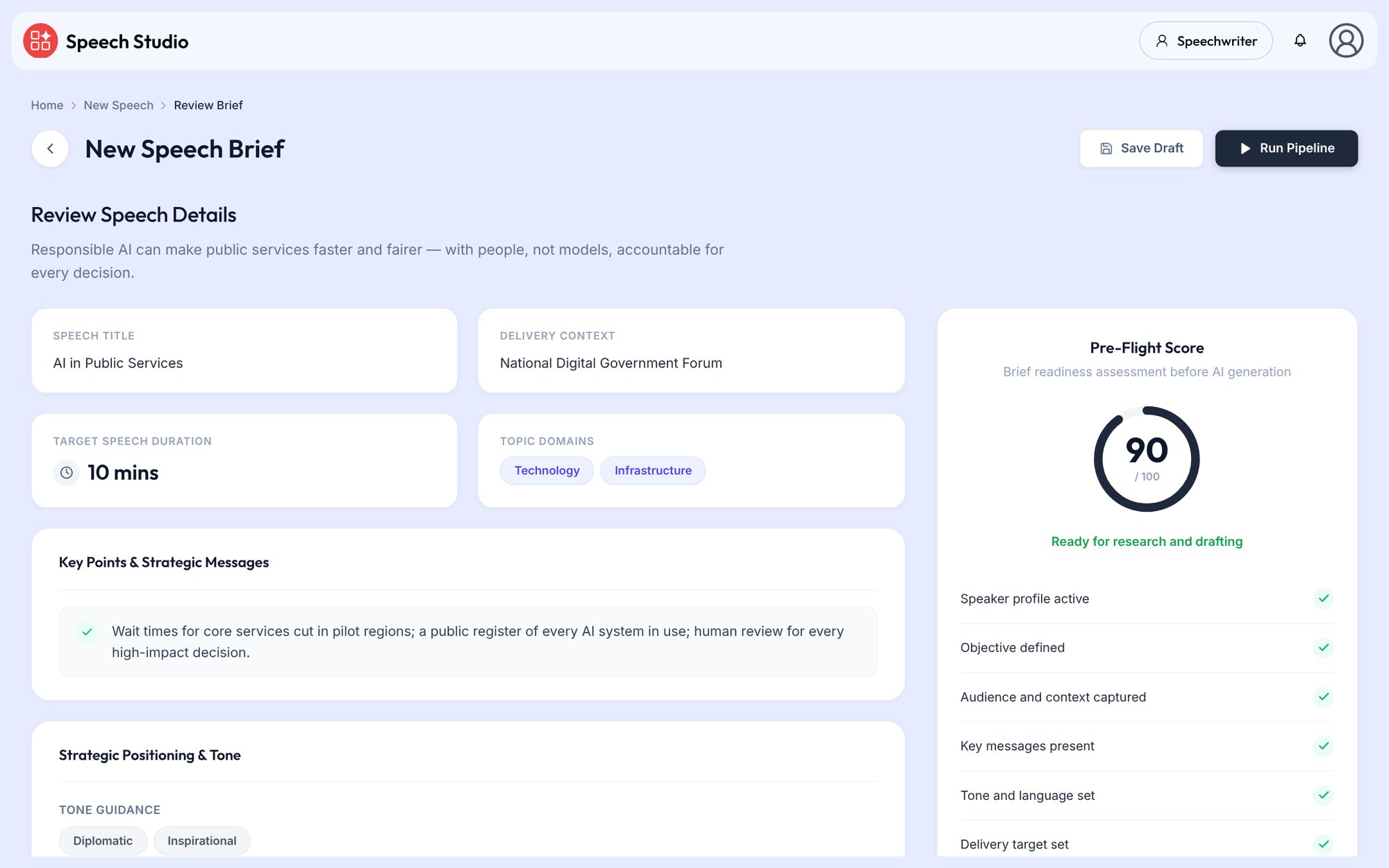
Generic AI drafts come from generic prompts. So the speech starts with a structured brief: occasion and audience, core thesis, key messages and facts, tone, must-include and must-avoid topics.
Before anything is generated, a pre-flight score rates the brief from 0 to 100 and lists what's missing. The warnings never block — a writer under pressure can always proceed — but they make it obvious when the output is going to be weaker than it needs to be.

Watching the machine work
Behind the brief sits a team of agents: one drafts against the leader's corpus of past speeches, one calibrates tone and flow, one extracts every factual claim and checks it against a list of trusted sources, and one adds delivery cues for the spoken word.
We showed that work instead of hiding it. The writer watches the pipeline move from thinking to research plan to tasks to reports — so the wait feels like progress, not a frozen screen.

Two layers of feedback, one editorial loop
In the editor, every check — fact, compliance, clarity, tone, structure, impact — has its own colour-coded highlight in the text, its own score, and its own alerts by severity. Click an alert and you land on the sentence.
Refinement is a conversation: ‘make the closing stronger’, ‘update the growth figure’, ‘shorten by a fifth’. Checks re-run as often as needed. An English version gets one extra check — translation consistency — and delivery cues (pause, emphasis, applause) are added last, with the text locked.


Approve or reject — and a record of everything
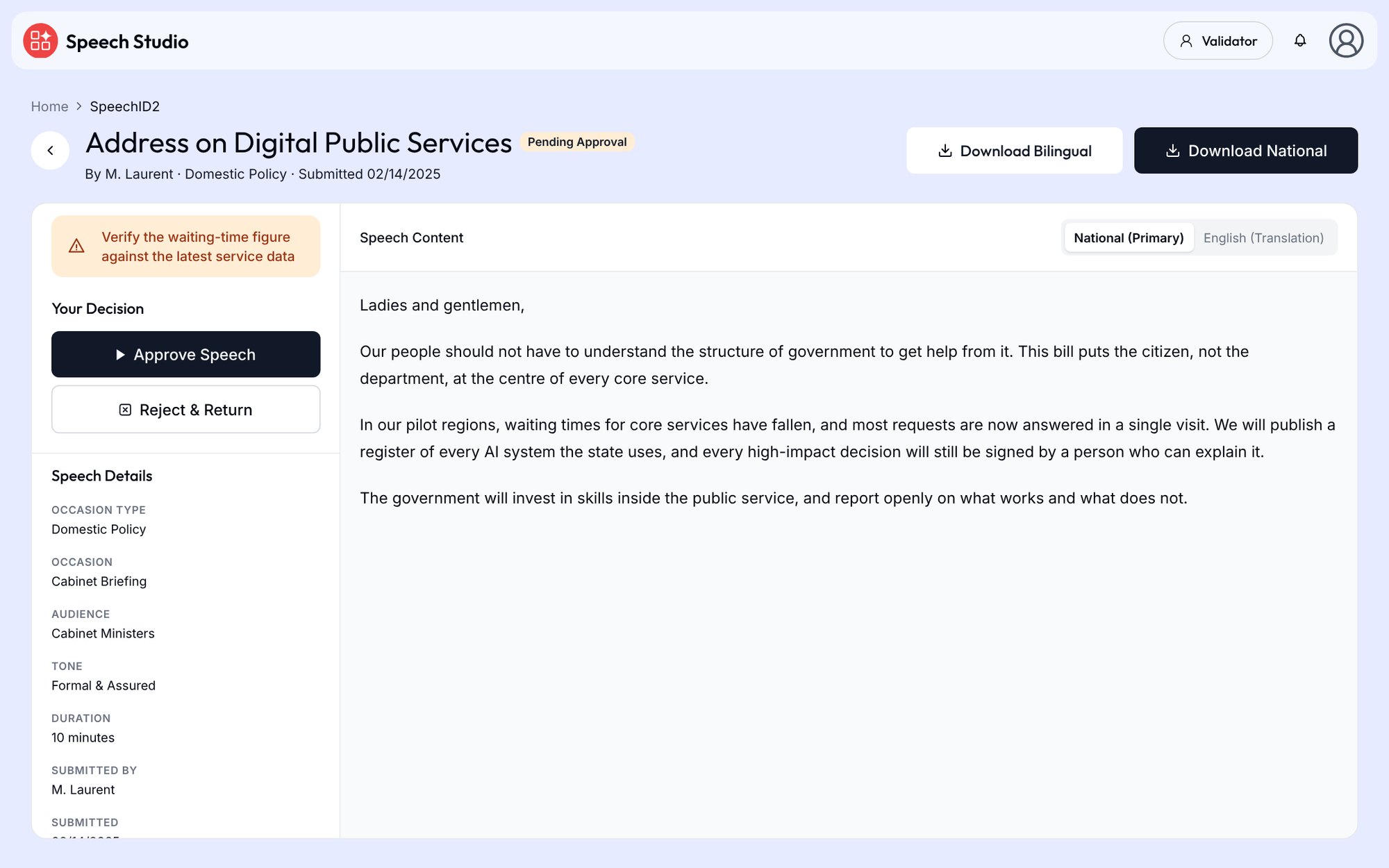
The validator sees the scores first, reads the speech with the alerts alongside, and makes one decision. A rejection goes back with a note; an approval tells the leader the speech is ready, in both languages, as a print-ready PDF.
Every event — brief, generation run, edit, check, command, decision — goes into an immutable audit trail. Trust comes from the record, not from locking people out of their own document.

The result
A platform where trust comes from the record, not from locking people out of their own document. Log everything; forbid nothing.
- Take 1
- 8 wks
- Discovery to design
- Take 2
- 25+
- Dev-ready screens
- Take 3
- 3
- Roles, one audit trail
 1Next · 06Open case
Next case · 06 / 12
Quoting at Fortune-20 scale
US telecom · Enterprise · CPQ · 2021–22
Three legacy tools folded into one quoting interface for a global sales team behind $3B+ a year — with an information architecture settled from a card sort only one in five people answered.
CASE 05 — GenAI · Government
Writing for a head of government
Case sheetCase No. 05
- Project
- Writing for a head of government
- Client
- European government office
- Category
- GenAI · Government
- Year
- 2026
- Role
- UX lead + client POC
- Team
- 8 weeks
LeadAmit Chotia2026
GenAI · GovernmentThe short version
Three users who can never see the same screen: the one who writes the speech, the one accountable for it, and the one who has to deliver it.
Outcome
25
25+ dev-ready screens across 3 roles
The brief
Three users who can never see the same screen: the person who writes the speech, the person accountable for it, and the head of government who has to deliver it. The platform generates compliance-checked bilingual speeches.
I held the client relationship and led UX across the platform in eight weeks. At government grade, the hard problems aren't visual — they're authority, audit, and what happens when the machine is wrong.
A speech in minutes, in a voice that isn't the machine's
A head of government has to speak well, often, and at short notice — in the national language and in English. The drafting was manual: a writer pulling facts from many sources, holding the leader's tone in their head, racing a deadline.
An AI that writes fast was never the hard part. The hard part was a draft that sounds like the leader, is factually airtight, flags what's politically sensitive, and still leaves a human accountable for every word.
Three people who never share a screen
The speechwriter owns the draft and lives with the deadline. Their stake is reputation: a wrong figure or a tonal misfire is theirs.
The validator is the final quality gate — senior, short on time, reviewing between meetings and often on paper. They need the quality scores before they read a word, and no version confusion.
The head of government only wants a speech that sounds like them, ready to deliver — and sometimes writes one on the go.
From brief to podium, with one hard gate
I mapped two workflows across three roles: a formal approval path, and an on-the-go path for the leader. One AI engine powers both.
The design principle that came out of it: everything in the system is advisory except one decision. The validator approves or rejects — with a mandatory note — and that's the only gate. Every other check informs; none of them lock the writer out of their own document. The journey maps went through seven versions, built and reviewed as working HTML.
The brief is the instruction
Generic AI drafts come from generic prompts. So the speech starts with a structured brief: occasion and audience, core thesis, key messages and facts, tone, must-include and must-avoid topics.
Before anything is generated, a pre-flight score rates the brief from 0 to 100 and lists what's missing. The warnings never block — a writer under pressure can always proceed — but they make it obvious when the output is going to be weaker than it needs to be.
Watching the machine work
Behind the brief sits a team of agents: one drafts against the leader's corpus of past speeches, one calibrates tone and flow, one extracts every factual claim and checks it against a list of trusted sources, and one adds delivery cues for the spoken word.
We showed that work instead of hiding it. The writer watches the pipeline move from thinking to research plan to tasks to reports — so the wait feels like progress, not a frozen screen.
Two layers of feedback, one editorial loop
In the editor, every check — fact, compliance, clarity, tone, structure, impact — has its own colour-coded highlight in the text, its own score, and its own alerts by severity. Click an alert and you land on the sentence.
Refinement is a conversation: ‘make the closing stronger’, ‘update the growth figure’, ‘shorten by a fifth’. Checks re-run as often as needed. An English version gets one extra check — translation consistency — and delivery cues (pause, emphasis, applause) are added last, with the text locked.
Approve or reject — and a record of everything
The validator sees the scores first, reads the speech with the alerts alongside, and makes one decision. A rejection goes back with a note; an approval tells the leader the speech is ready, in both languages, as a print-ready PDF.
Every event — brief, generation run, edit, check, command, decision — goes into an immutable audit trail. Trust comes from the record, not from locking people out of their own document.
The result
A platform where trust comes from the record, not from locking people out of their own document. Log everything; forbid nothing.
- Take 1
- 8 wks
- Discovery to design
- Take 2
- 25+
- Dev-ready screens
- Take 3
- 3
- Roles, one audit trail
1Next · 06Open caseNext case · 06 / 12
Quoting at Fortune-20 scale
US telecom · Enterprise · CPQ · 2021–22
Three legacy tools folded into one quoting interface for a global sales team behind $3B+ a year — with an information architecture settled from a card sort only one in five people answered.
CASE 05 — GenAI · Government
Writing for a head of government
Case sheetCase No. 05
- Project
- Writing for a head of government
- Client
- European government office
- Category
- GenAI · Government
- Year
- 2026
- Role
- UX lead + client POC
- Team
- 8 weeks
LeadAmit Chotia2026
GenAI · GovernmentThe short version
Three users who can never see the same screen: the one who writes the speech, the one accountable for it, and the one who has to deliver it.
Outcome
25
25+ dev-ready screens across 3 roles
The brief
Three users who can never see the same screen: the person who writes the speech, the person accountable for it, and the head of government who has to deliver it. The platform generates compliance-checked bilingual speeches.
I held the client relationship and led UX across the platform in eight weeks. At government grade, the hard problems aren't visual — they're authority, audit, and what happens when the machine is wrong.
A speech in minutes, in a voice that isn't the machine's
A head of government has to speak well, often, and at short notice — in the national language and in English. The drafting was manual: a writer pulling facts from many sources, holding the leader's tone in their head, racing a deadline.
An AI that writes fast was never the hard part. The hard part was a draft that sounds like the leader, is factually airtight, flags what's politically sensitive, and still leaves a human accountable for every word.
Three people who never share a screen
The speechwriter owns the draft and lives with the deadline. Their stake is reputation: a wrong figure or a tonal misfire is theirs.
The validator is the final quality gate — senior, short on time, reviewing between meetings and often on paper. They need the quality scores before they read a word, and no version confusion.
The head of government only wants a speech that sounds like them, ready to deliver — and sometimes writes one on the go.
From brief to podium, with one hard gate
I mapped two workflows across three roles: a formal approval path, and an on-the-go path for the leader. One AI engine powers both.
The design principle that came out of it: everything in the system is advisory except one decision. The validator approves or rejects — with a mandatory note — and that's the only gate. Every other check informs; none of them lock the writer out of their own document. The journey maps went through seven versions, built and reviewed as working HTML.
The brief is the instruction
Generic AI drafts come from generic prompts. So the speech starts with a structured brief: occasion and audience, core thesis, key messages and facts, tone, must-include and must-avoid topics.
Before anything is generated, a pre-flight score rates the brief from 0 to 100 and lists what's missing. The warnings never block — a writer under pressure can always proceed — but they make it obvious when the output is going to be weaker than it needs to be.
Watching the machine work
Behind the brief sits a team of agents: one drafts against the leader's corpus of past speeches, one calibrates tone and flow, one extracts every factual claim and checks it against a list of trusted sources, and one adds delivery cues for the spoken word.
We showed that work instead of hiding it. The writer watches the pipeline move from thinking to research plan to tasks to reports — so the wait feels like progress, not a frozen screen.
Two layers of feedback, one editorial loop
In the editor, every check — fact, compliance, clarity, tone, structure, impact — has its own colour-coded highlight in the text, its own score, and its own alerts by severity. Click an alert and you land on the sentence.
Refinement is a conversation: ‘make the closing stronger’, ‘update the growth figure’, ‘shorten by a fifth’. Checks re-run as often as needed. An English version gets one extra check — translation consistency — and delivery cues (pause, emphasis, applause) are added last, with the text locked.
Approve or reject — and a record of everything
The validator sees the scores first, reads the speech with the alerts alongside, and makes one decision. A rejection goes back with a note; an approval tells the leader the speech is ready, in both languages, as a print-ready PDF.
Every event — brief, generation run, edit, check, command, decision — goes into an immutable audit trail. Trust comes from the record, not from locking people out of their own document.
The result
A platform where trust comes from the record, not from locking people out of their own document. Log everything; forbid nothing.
- Take 1
- 8 wks
- Discovery to design
- Take 2
- 25+
- Dev-ready screens
- Take 3
- 3
- Roles, one audit trail
1Next · 06Open caseNext case · 06 / 12
Quoting at Fortune-20 scale
US telecom · Enterprise · CPQ · 2021–22
Three legacy tools folded into one quoting interface for a global sales team behind $3B+ a year — with an information architecture settled from a card sort only one in five people answered.
Contact…
Let's build the next best experience.
Gurgaon · IST
Hiring for design leadership, or a journey that needs someone to look at it from the other side? Write to me — I reply within a day.
Open toDesign leadership roles
Working from
Contact…
Let's build the next best experience.
Gurgaon · IST
Hiring for design leadership, or a journey that needs someone to look at it from the other side? Write to me — I reply within a day.
Open toDesign leadership roles
Working from
Contact…
Let's build the next best experience.
Gurgaon · IST
Hiring for design leadership, or a journey that needs someone to look at it from the other side? Write to me — I reply within a day.
Open toDesign leadership roles
Working from
That's a wrap.
Thanks for reading to the end. Say hello — I read every message and reply within a day.
Write to meamitchotia9@gmail.com